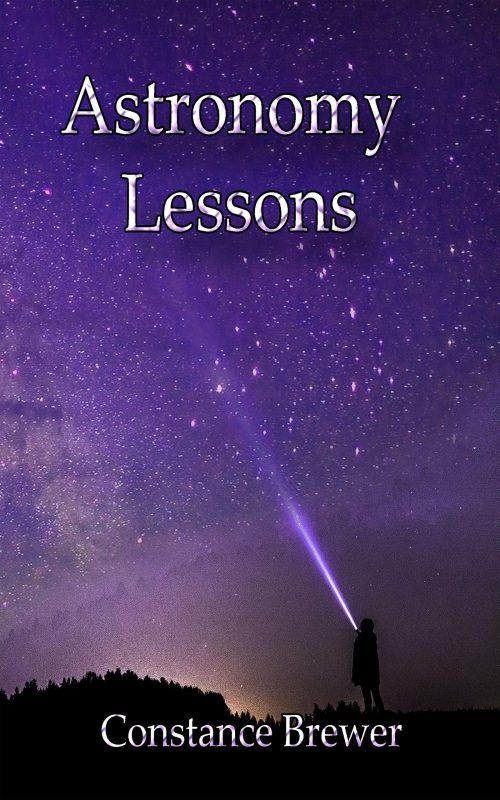
Astronomy Lessons – New Poetry Book

Astronomy Lessons front cover

My new poetry book is finally here! Introducing Astronomy Lessons, a book of poems exploring the relationships between myth, science, and creating meaning from the night sky.

Praise for Astronomy Lessons

Ever dreamed of becoming a constellation? It may not be what you imagine. In this collection, Constance Brewer takes on multiple personas, modern and mythological, all attempting to wrestle with “things (they) don’t understand—/ cosmology, evolution, personal relationships” through metaphors and motifs of astronomy.  Using cosmic imagery and lyrical storytelling these poems take us through the trajectory of growing up, growing older, finding and losing love, and looking for it again, all against the backdrop of a cosmos that is comparatively vast and yet familiar. Though this collection seeks for wisdom, it often leaves us with the mystery of unanswerable questions, like “what should we think about before we drink from the river Lethe” and “what is love but a failed picture of the moon?”

—Tresha Faye Haefner, author of When the Moon Had Antlers (Pine Row Press, 2023, Finalist for the Glass Lyre Poetry Prize) and Founder of The Poetry Salon

Constance Brewer’s Astronomy Lessons scatters poems across the night sky of an emotional landscape we all know: love. Whether love’s objects are lovers, parents, children, or earth itself, these poems orbit around that which pulls us to reach farther, hold tighter, look deeper. The physics of love are everywhere. Brewer writes, It’s the passage of filament from one person / to another where theory goes astray….leaving us unable to explain the one thing / that would help us explain everything. Yet these poems somehow contain everything we might feel as we gaze upward, when we’re waiting / for science, having long given up on gods. That’s when we understand we are all made of star dust.

—Kathleen Cassen Mickelson, co-founding editor of Gyroscope Review, and co-author of Prayer Gardening.

Excerpt from Astronomy Lessons

Click HERE for PDF Excerpt

Astronomy Lessons is available on Amazon as a paperback and as a Kindle ebook
Copies are also available from the author.

On writing Astronomy Lessons

Myth and science both seek to explain the world. Myth is not failed science; it is the engine that drives the What If of a curious mind. What haunts the intersection of science and mythology? That’s what we’d love to discover. Just because the stars are impossibly far away doesn’t mean they don’t have stories to tell. Astronomy Lessons looks to the stars to help explain what it means to be human. We create meaning out of the night sky—part truth, part fiction, and common to us all. Poetry is a search for our own creation myth, and the ritual of examining the night sky is the path to discovering the mythic being inside us all. —Constance Brewer

 Other Poetry Books by Constance Brewer
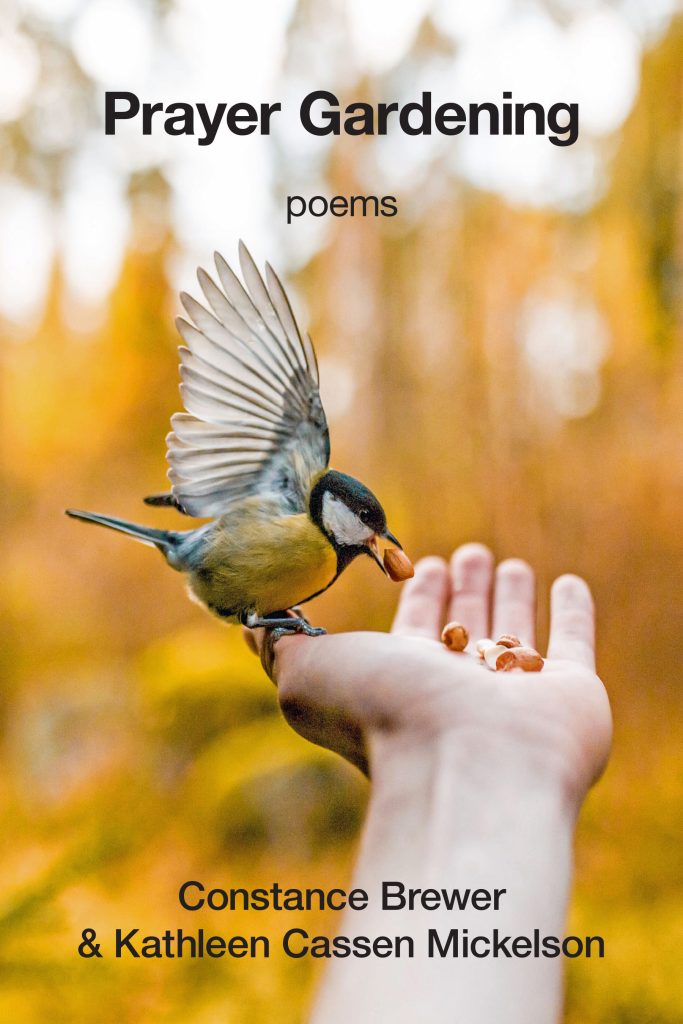
   

Prayer Gardening front cover

Prayer Gardening available on Amazon or from Kelsay Books. Also available from the Author.

Video excerpts of Prayer Gardening are available on the website.

Prayer Gardening was co-authored with poet Kathleen Cassen Mickelson. We’ve worked together for years, first as co-founders of Gyroscope Review poetry magazine, then exchanging poems for critiques. Our work covered similar interests and themes, and this collection grew organically out of our poetic conversations. Prayer Gardening speaks of the way we connect to each other, nature, and the world around us. It takes a deep dive into what makes us human, and how we forge relationships. The chapbook alternates between two voices that explore connections and discover our similarities more than our differences.
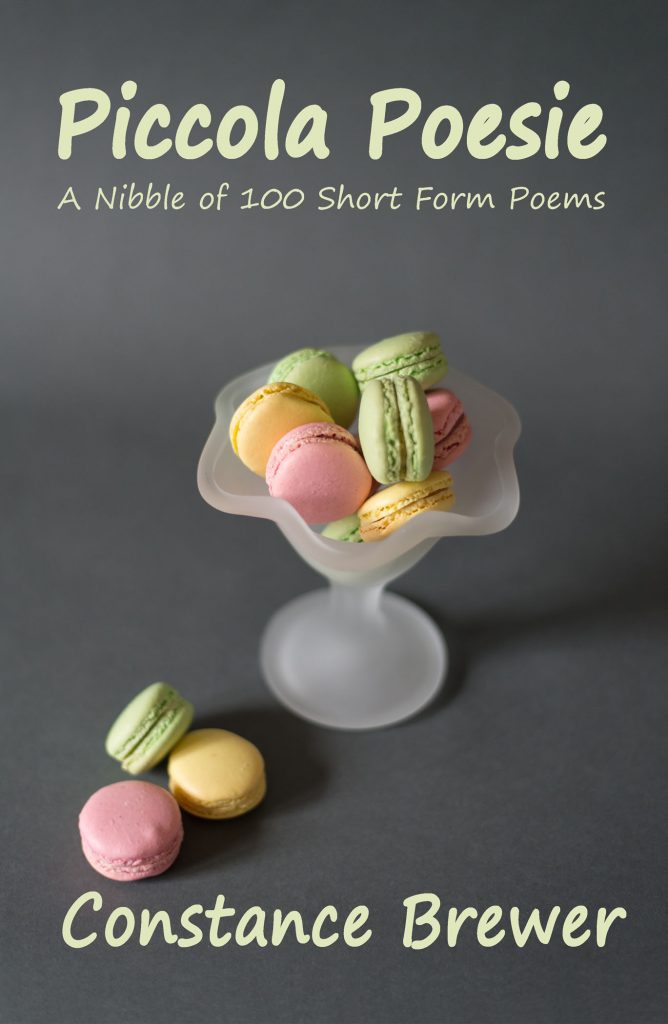
Piccola Poesie - poems by Constance Brewer

Piccola Poesie is available on Amazon at a special price for a limited time.

Piccola Poesie PDF excerpt

Piccola Poesie contains a variety of Haiku, Senryu, Tanka, and American Sentences that explore human relationships with nature, with other people, and with inanimate objects. The poems wheel through the seasons, dropping observations and commentary on life. In these short, easily digestible poems, the reader can find answers to questions like, What’s up with cats, anyhow? and why winter causes the poet to rush outside to witness the season. Like macarons, the reader can enjoy these poems as a day-by-day treat, or gobble them down by the handful. 100 small bite poems for a fast-moving world.

ADHD-ing My Way to Writing Success

Working with the ADHD Brain

I have a blank space in my brain between the trip to London in the spring and OMG kids (not mine) are going back to school. I think it’s called summer-oh no-what happened-it’s-fall. It’s been hotter than ever in my corner of the U.S., highest temp on the back porch was 111—in the shade. Daily it was 90 to 100 with the 90s hitting about 9 a.m. Needless to say I didn’t get much done outside the house except scanning the horizon for wildfires. Now it’s almost November and I’m still wearing shorts and a t-shirt. Still scanning for wildfires.

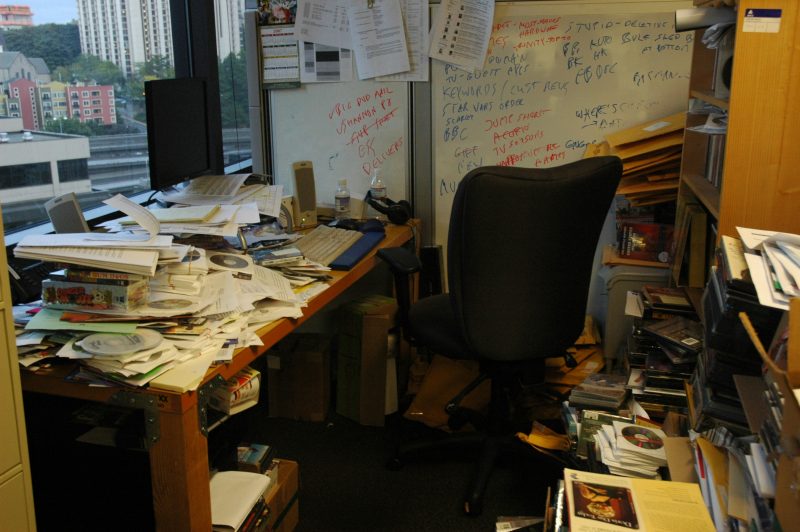
messy desk

Inside, however, is another story. Lots of writing going on. My ADHD brain decided to juggle the sequel to one contemporary fantasy novel, a second epic fantasy novel, and poems all at the same time. I’m holding multiple characters in my head, and you know what? It’s working. Such is the superpower of ADHD. Compartmentalizing and switching tracks on a moment’s notice. I wish I had seen it as a superpower long ago instead of a detriment as I was told.

It also holds the ability to hyper-focus, allowing me to actually do one paragraph and more outlines of chapters. Me, outlining more than a sentence. (Checks outside for flying pigs. Who would be crispy bacon in the heat.) It’s helped lock in that compartmentalizing part of my brain. If I got stuck on one story, I hopped to the other. Or poetry. Or some artwork. (Housecleaning, not so much.) Rinse, repeat.

Neat desk

I used Scrivener to do the outlining because I really like the corkboard function. It’s probably what trolled me over to the dark side. (Outlining). Then I slowly came around to other methods of outlining after a nifty fiction writers meeting. They helped explain what each part of the outlining method was supposed to do. And I understood it! Finally! I think combining the showing part of the presentation, examples, and hearing it aloud helped tremendously. I’But never fear, I still pants some of my chapters when the outline isn’t quite loosey goosey enough. So the best of both worlds, really.

I haven’t quite adapted to using Scrivener for the actual writing part. (Or Auto Crit) I think too many years of using Word makes it the more comfortable option. Technology—including air conditioning—has made this a season—or two seasons rather—to get serious writing done. I usually look forward to winter for writing, trapped in the house is prime time to let the percolating thoughts loose. But right now it falls to fall to be my vizualization time. The cool mornings, hot afternoons, and cool to cold nights fit my fickle brain perfectly. So I’ll stay in my bubble and crank out more words. Then we’ll see how ADHD brain handles editing this time around. Despite the flip-flopping thought process, perfectionism is still a thing. How do you multitask? Does perfectionism get in the way of your writing?

Outside Links

Why people with ADHD make great writers

Writers with ADHD

Links to More of My Essays on Writing

Is Writing Time Absolute?

Writing in Dual POVs (or more)

A Meditation on Walking and Writing

Using Weaving for Bursts of Writing Creativity

Figuring it Out as You Go

Find More Essays on My Non-Fiction Tab

Is Writing Time Absolute?

Let's Rock Mittens Front
“Let’s Rock” Mittens Front

Just before the first snow arrived I got the urge to pick up my knitting again. I tend to slack off during the warm summer months as I like knitting with wool and it can get warm. I don’t do much weaving in the summer either. I think fiber arts go by the wayside in general during the hot weather. Too much to do outside. Jumping back into doing a colorwork hat, I forgot how much I enjoyed the meditative quality of knitting. Around and around, flicks of contrasting colors here and there, plenty of time to contemplate other things besides the Yankees totally blowing the playoffs. (I’m not bitter. Much) What do I contemplate? My latest writing problems mainly. 

I’m down to plugging the holes in my Next Fantasy Novel. I’ve outlined cards in Scrivener, most marked “Final Draft” but there are still half a dozen chapters marked “To do”. I jotted down the idea for each To Do chapter on the cards. Somewhere in novel one, I discovered I could break away from my rigid linear thinking, scribble down a one-paragraph outline for a chapter, and roll merrily onward. Some writers may scoff, having done this all along. I had to shake loose from my rigid expectation that the only way I could make progress on the novel was to slog through it in order. What comes next? Write that. Next? Next? It was keeping me from seeing the possibilities jumping around provided. (Not gonna lie, the thought of working out of order still makes me cringe.)

Fiber Arts as Teacher

Maybe it came from knitting patterns, where you have to do things in order or you end up with a Frankensweater, or off-kilter colorwork. Every pattern has its progression. A-Z with no stops in between. Then I got wild and crazy with the knitting and weaving. I warped my loom the normal way, started weaving, and wondered, what if I changed the weft yarn to this multicolored thick yarn? So I did. It was shocking. Intriguing. And pretty cool looking. I played around with different yarns in the same project. It circled me back to my roots as an artist in grad school, where experimenting was the norm. Where did I lose that? 

Writing Time

I think when I ran out of big blocks of time to work. If you’re going to squish a project into the little bits of time after work, you don’t want to make any mistakes. You want perfectionism. But mistakes are where the fun’s hiding. Instead of forcing my writing to march forward in line, I scribbled ideas down in Scrivener, grabbed a Chapter card, and started writing. When I finished, I tackled another one. My pantsy outlining was the key, enough info in a paragraph to point me in the right direction, but not enough to lose the fun of exploring where the idea was going. Too much outlining always made me feel as if I already knew the story. So why write it?

Writing Roots

Knitting was the same, sorta. I grabbed a pattern and used it to learn the technique, going in with the mindset I may have to rip it all out and start again. Instead of bemoaning all the time wasted, I became more careful with how I progressed, setting stitch markers to keep track of repeats, and marking charts to note progress. Technical ability increased my confidence. So it went with the writing. I found my outlining sweet spot, not afraid to go back and rewrite shaky parts, and revise the outline. None of it was a waste of time when I had a goal to shoot for, and didn’t let my anal retentive need for complete control take over. My first Norwegian Star hat has a wonky tip on one star. Nobody noticed it but me. The Rock and Roll mittens have a few miscues. The recipient didn’t care.

Let's Rock Mittens Back
“Let’s Rock” Mittens Back
& Skulls Hat

My new mantra? Let it go. What’s the worst that could happen? (Besides getting the Frozen theme song stuck in your head.) I’m my own worst critic. But I don’t have to be. I’ve even learned to knit a sock toe-up instead of top-down. Flipping my expectations. If it doesn’t work out, rip it apart and start again. Einstein showed in his thought experiments that people traveling at different speeds, while agreeing on cause and effect, measure different time separations between events. (Wikipedia). I’m going to quit measuring the time I don’t have and work with what I do have. My time is not your time. I’ll travel at my own speed, and if it’s not perfectly linear, well, that’s okay. 

Let’s Rock Mitten Pattern

Skull Hat Pattern

Essays on Writing:

How Cats Help You Write

Figuring it Out as You Go

More Lessons From Printmaking

Using Weaving for Bursts of Writing Creativity

What I Learned from Editing

For other essays, search the Writing or Writing Process tags.

How Cats Help You Write

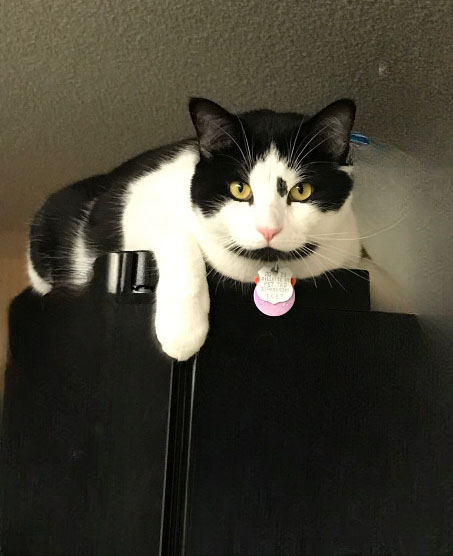
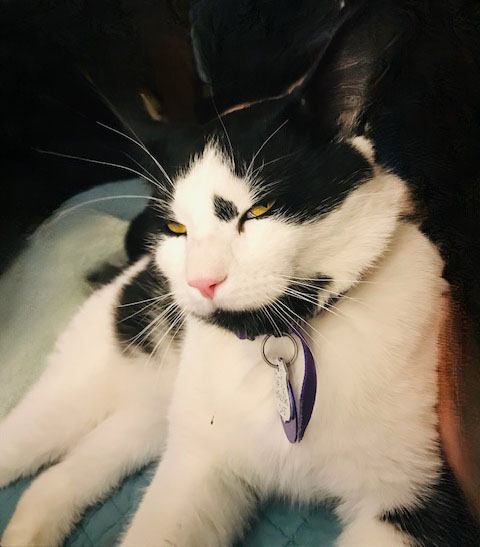
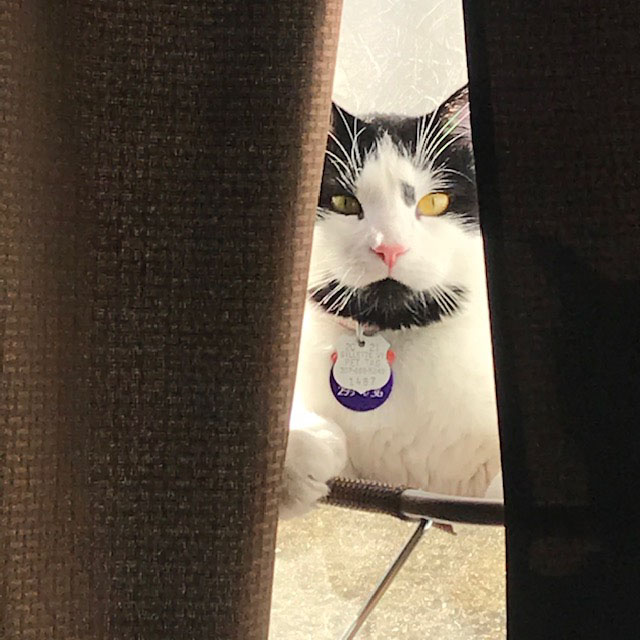
How do cats help you write? By focusing the eyes of judgment upon you. Continuously. Under the heavy scrutiny of a feline, one tends to look at their work with a more critical eye. No? Just me? My Tuxedo cat, Lorenzo, likes to sprawl on the bookcase across the room and watch me as I write. I’m hyper-aware of those yellow eyes observing and judging. Especially when I read a passage aloud. 

It’s bad enough to have to listen to my voice attempting to add inflection and create different voices for the characters. I can’t help it, I glance over at the cat as I’m doing it. He stares with eyes narrowed to slits. The tail gives a lazy flick. My words suddenly become weak under the weight of feline perception. I click and highlight puny words, and rearrange sentences. Remake, redo, rewrite. 

How Cats Really Help You Write

Lorenzo never jumps in my lap and attempts to comfort me. Or change my prose. He doesn’t walk across my keyboard. Well, he did once when he was new, but never since. Rewriting is not his job. Instead, he skulks above on the bookcase, peering down, forming opinions and conclusions, black and white face a mask of indifference. If that’s not a hypercritical reader, I don’t know what is. Not much awes a cat. 

(The Corgis would gasp and gush “I love it!” even if I read them a grocery list.)

How Cats Help You Write

Sometimes my spoken words get scant approval. He lazes with a paw hanging over the edge of the bookcase, head turned away, the cat version of impressed. I feel good. “This is a new chapter,” I tell him. “The one where the hero realizes the antagonist is not who he thought it was. Life is about to get worse.”

Lorenzo rolls over, crouches, and leaps the six feet to the floor. A big stretch, then a whack to a toy mouse in his way. He pounces, rolls over, savages it, back feet flailing, claws digging. This goes on for a good five minutes. Finished, he spares a glance for me and utters a cross between a soft yowl and a gurgle. He stalks over to his cat tree, climbs to the tallest bed in the tower, and curls up for a nap, back to me. 

Rewrite, Human Slave. It’s Your Only Hope

Message received. My hero needs to suffer more. The great revelation needs punching up. I pound away at the keyboard in a frenzy, rewriting, tossing my hero off a cliff into a pit full of stinging jellyfish riding the backs of pissed-off alligators. Hours later I read it aloud, gratified when Lorenzo uncurls from his sunny perch to come over, staring up with unblinking yellow eyes. He admits several vocalizations that sound more like guttural wahs than meows. Does it mean I’ve done it? Impressed the judgmental cat?

No. 

It’s dinner time. 

How Cats help You Write

More Essays

More Lessons from Printmaking

A Meditation on Walking and Writing

What I Learned From Editing

Finished and Starting Again

Pulling Words Apart to Smash Writing Together

Outside Links

The Relationship Between Famous Writers & Their Cats

Writing with Cats

Back to Top