Astronomy Lessons – New Poetry Book

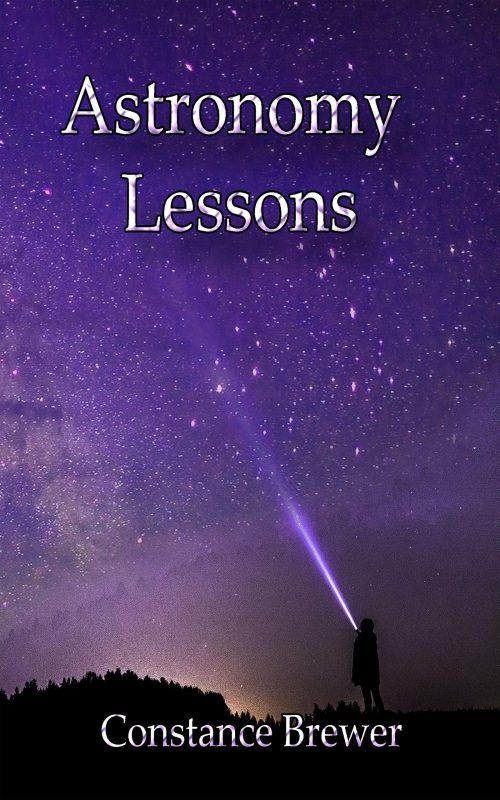
Astronomy Lessons front cover

My new poetry book is finally here! Introducing Astronomy Lessons, a book of poems exploring the relationships between myth, science, and creating meaning from the night sky.

Praise for Astronomy Lessons

Ever dreamed of becoming a constellation? It may not be what you imagine. In this collection, Constance Brewer takes on multiple personas, modern and mythological, all attempting to wrestle with “things (they) don’t understand—/ cosmology, evolution, personal relationships” through metaphors and motifs of astronomy.  Using cosmic imagery and lyrical storytelling these poems take us through the trajectory of growing up, growing older, finding and losing love, and looking for it again, all against the backdrop of a cosmos that is comparatively vast and yet familiar. Though this collection seeks for wisdom, it often leaves us with the mystery of unanswerable questions, like “what should we think about before we drink from the river Lethe” and “what is love but a failed picture of the moon?”

—Tresha Faye Haefner, author of When the Moon Had Antlers (Pine Row Press, 2023, Finalist for the Glass Lyre Poetry Prize) and Founder of The Poetry Salon

Constance Brewer’s Astronomy Lessons scatters poems across the night sky of an emotional landscape we all know: love. Whether love’s objects are lovers, parents, children, or earth itself, these poems orbit around that which pulls us to reach farther, hold tighter, look deeper. The physics of love are everywhere. Brewer writes, It’s the passage of filament from one person / to another where theory goes astray….leaving us unable to explain the one thing / that would help us explain everything. Yet these poems somehow contain everything we might feel as we gaze upward, when we’re waiting / for science, having long given up on gods. That’s when we understand we are all made of star dust.

—Kathleen Cassen Mickelson, co-founding editor of Gyroscope Review, and co-author of Prayer Gardening.

Excerpt from Astronomy Lessons

Click HERE for PDF Excerpt

Astronomy Lessons is available on Amazon as a paperback and as a Kindle ebook
Copies are also available from the author.

On writing Astronomy Lessons

Myth and science both seek to explain the world. Myth is not failed science; it is the engine that drives the What If of a curious mind. What haunts the intersection of science and mythology? That’s what we’d love to discover. Just because the stars are impossibly far away doesn’t mean they don’t have stories to tell. Astronomy Lessons looks to the stars to help explain what it means to be human. We create meaning out of the night sky—part truth, part fiction, and common to us all. Poetry is a search for our own creation myth, and the ritual of examining the night sky is the path to discovering the mythic being inside us all. —Constance Brewer

 Other Poetry Books by Constance Brewer
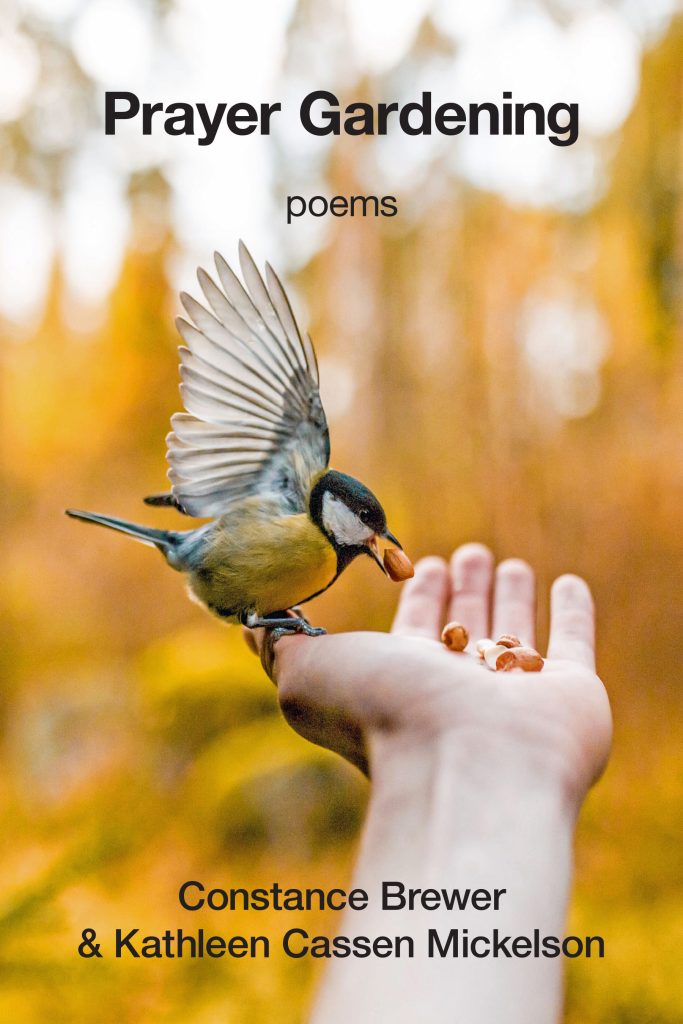
   

Prayer Gardening front cover

Prayer Gardening available on Amazon or from Kelsay Books. Also available from the Author.

Video excerpts of Prayer Gardening are available on the website.

Prayer Gardening was co-authored with poet Kathleen Cassen Mickelson. We’ve worked together for years, first as co-founders of Gyroscope Review poetry magazine, then exchanging poems for critiques. Our work covered similar interests and themes, and this collection grew organically out of our poetic conversations. Prayer Gardening speaks of the way we connect to each other, nature, and the world around us. It takes a deep dive into what makes us human, and how we forge relationships. The chapbook alternates between two voices that explore connections and discover our similarities more than our differences.
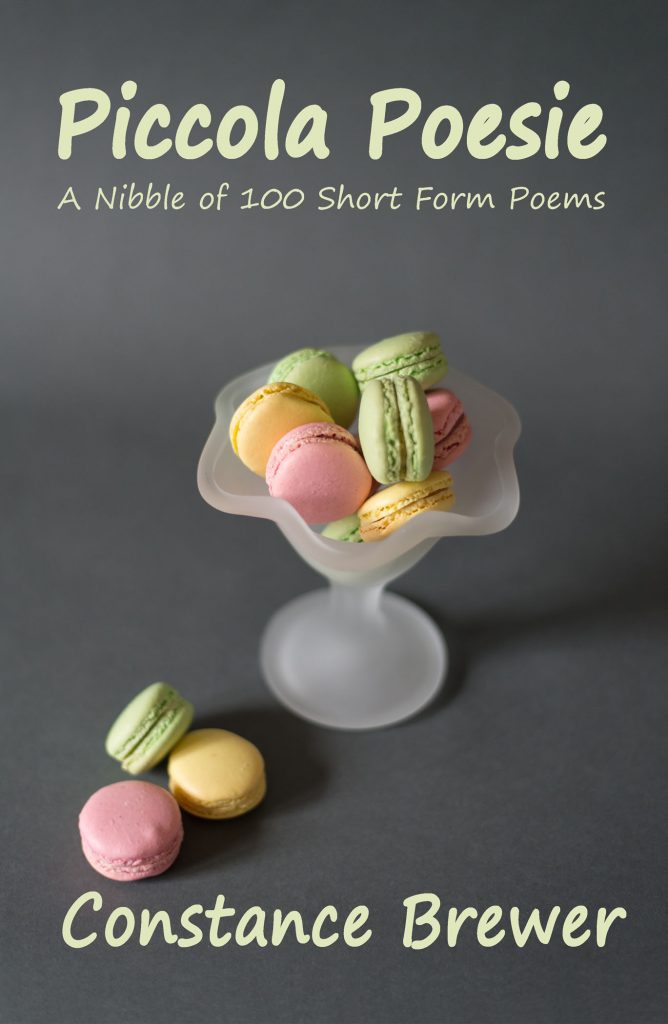
Piccola Poesie - poems by Constance Brewer

Piccola Poesie is available on Amazon at a special price for a limited time.

Piccola Poesie PDF excerpt

Piccola Poesie contains a variety of Haiku, Senryu, Tanka, and American Sentences that explore human relationships with nature, with other people, and with inanimate objects. The poems wheel through the seasons, dropping observations and commentary on life. In these short, easily digestible poems, the reader can find answers to questions like, What’s up with cats, anyhow? and why winter causes the poet to rush outside to witness the season. Like macarons, the reader can enjoy these poems as a day-by-day treat, or gobble them down by the handful. 100 small bite poems for a fast-moving world.


Five Poems That Pulled Me Into Poetry

Do you remember which poems pulled you into poetry? The ones that dazzled and beguiled you? I was given a book of poems very early by my grandmother and grew fascinated by the rhythm and the words. I was lucky enough to have elementary school teachers that emphasized poetry in their literature lessons. Memorizing a poem gave me a friend to recite in my head whenever I needed. Of course, a steady diet of Shakespeare in high school helped me fall in love with poetry also. Here are the five poems, in no particular order.

First Poem

My grandfather gave me a book that had the following poem in it. Among all the others it stood out. I didn’t live near the ocean, just visited it on vacations, but the poem has such longing and romanticism in it I couldn’t help but be enraptured. I was always reading history and historical novels in school, so this one captured my imagination.

    Sea Fever
    by John Masefield

    I must go down to the seas again, to the
          lonely sea and the sky,
    And all I ask is a tall ship and a star to steer
          her by;
    And the wheel’s kick and the wind’s song and
          the white sail’s shaking,
    And a grey mist on the sea’s face, and a grey
          dawn breaking.
    I must go down to the seas again, for the call
          of the running tide
    Is a wild call and a clear call that may not be
          denied;
    And all I ask is a windy day with the white
         clouds flying,
    And the flung spray and the blown spume, and
          the sea-gulls crying.
    I must go down to the seas again, to the
          vagrant gypsy life,
    To the gull’s way and the whale’s way, where
          the wind’s like a whetted knife;
    And all I ask is a merry yarn from a laughing
          fellow-rover,
    And quiet sleep and a sweet dream when the
          long trick’s over.

Second Poem

I have a very old copy of the Complete Poems of Robert Frost. I don’t know where it came from or how long I’ve had it, but this poem is bookmarked. It is very evocative and reminds me of Christopher Marlowe’s poems. Of course I love all the classic Frost poems, “The Road Not Taken”, “Stopping by Woods on a Snowy Evening”, “Birches”, “Mending Wall”, and “Nothing Gold Can Stay”.

    A Line-storm Song
    by Robert Frost


    The line-storm clouds fly tattered and swift, 
      The road is forlorn all day, 
    Where a myriad snowy quartz stones lift, 
      And the hoof-prints vanish away. 
    The roadside flowers, too wet for the bee,
      Expend their bloom in vain. 
    Come over the hills and far with me, 
      And be my love in the rain. 


    The birds have less to say for themselves 
      In the wood-world’s torn despair
    Than now these numberless years the elves, 
      Although they are no less there: 
    All song of the woods is crushed like some 
     Wild, easily shattered rose. 
    Come, be my love in the wet woods; come,
      Where the boughs rain when it blows. 


    There is the gale to urge behind 
      And bruit our singing down, 
    And the shallow waters aflutter with wind 
      From which to gather your gown.    
    What matter if we go clear to the west, 
      And come not through dry-shod? 
    For wilding brooch shall wet your breast 
      The rain-fresh goldenrod. 


    Oh, never this whelming east wind swells   
      But it seems like the sea’s return 
    To the ancient lands where it left the shells 
      Before the age of the fern; 
    And it seems like the time when after doubt 
      Our love came back amain.      
    Oh, come forth into the storm and rout 
      And be my love in the rain.

Third Poem

Then there’s Emily Dickinson. She wove in and out of my early poem reading, and I fell in love with her succinct style that said so much. She’s still one of my favorite poets. Setting Sail, as it got titled somewhere along the way, is one poem I memorized because it speaks to me as a landlubber who finally went out to sea.

    Emily Dickinson

    VII.

    SETTING SAIL.

    Exultation is the going
    Of an inland soul to sea, —
    Past the houses, past the headlands,
    Into deep eternity!

    Bred as we, among the mountains,
    Can the sailor understand
    The divine intoxication
    Of the first league out from land?

Fourth Poem

I stumbled across High Flight while reading some WWII history. Our family has close ties to aviation, my father worked in the industry. Some vacations we’d drive out to that city’s airport and watch the planes take off and land. There were pilgrimages to the Air and Space Museum. In the Army I even put in to fly helicopters. Alas, my eyesight wasn’t good enough. 

John Gillespie Magee Jr., the RAF poet, wrote very few poems during WWII but sent them to his parents in letters. He was killed in a training accident on December 11, 1941. I think of this poem whenever I hear one of my favorite songs – Pink Floyd’s Learning to Fly. Both speak to pilots, astronauts, and wanna be flyers everywhere.

    High Flight
    by John Gillespie Magee Jr.


    Oh! I have slipped the surly bonds of Earth
    And danced the skies on laughter-silvered wings;
    Sunward I've climbed, and joined the tumbling mirth
    of sun-split clouds,—and done a hundred things
    You have not dreamed of—wheeled and soared and swung
    High in the sunlit silence. Hov'ring there,
    I've chased the shouting wind along, and flung
    My eager craft through footless halls of air ....

    Up, up the long, delirious, burning blue
    I've topped the wind-swept heights with easy grace
    Where never lark nor ever eagle flew—
    And, while with silent lifting mind I've trod
    The high untrespassed sanctity of space,
    Put out my hand, and touched the face of God.

Learning to Fly video

Lyrics:

    Learning to Fly

    Into the distance, a ribbon of black
    Stretched to the point of no turning back
    A flight of fancy on a wind swept field
    Standing alone my senses reeled
    A fatal attraction is holding me fast
    How can I escape this irresistible grasp?

    Can't keep my eyes from the circling sky
    Tongue-tied and twisted, just an earth-bound misfit, I

    Ice is forming on the tips of my wings
    Unheeded warnings, I thought I thought of everything
    No navigator to find my way home
    Unladened, empty, and turned to stone

    A soul in tension that's learning to fly
    Condition grounded but determined to try
    Can't keep my eyes from the circling skies
    Tongue-tied and twisted, just an earth-bound misfit, I

    Friction lock, set
    Mixtures, rich
    Propellers, fully forward
    Flaps, set - 10 degrees
    Engine gauges and suction, check

    Above the planet on a wing and a prayer
    My grubby halo, a vapor trail in the empty air
    Across the clouds I see my shadow fly
    Out of the corner of my watering eye
    A dream unthreatened by the morning light
    Could blow this soul right through the roof of the night

    There's no sensation to compare with this
    Suspended animation, a state of bliss
    Can't keep my mind from the circling sky
    Tongue-tied and twisted, just an earth-bound misfit, I


    Songwriters: Tom Petty, Jeff Lynne
    For non-commercial use only.

Last but not least

Of course, no influence of mine would ever be complete without the main man himself, William Shakespeare. I ran into Shakespeare in high school English class, first in plays we acted out, then through the sonnets. There are many sonnets I like, sometimes it depends on the day and how I’m feeling. But if I had to choose just one, this would be it.

    William Shakespeare
    Sonnet 14: Not From The Stars Do I My Judgement Pluck

    Not from the stars do I my judgement pluck;
    And yet methinks I have Astronomy,
    But not to tell of good or evil luck,
    Of plagues, of dearths, or seasons’ quality;
    Nor can I fortune to brief minutes tell,
    Pointing to each his thunder, rain and wind,
    Or say with princes if it shall go well
    By oft predict that I in heaven find:
    But from thine eyes my knowledge I derive,
    And, constant stars, in them I read such art
    As truth and beauty shall together thrive,
    If from thyself, to store thou wouldst convert;
    Or else of thee this I prognosticate:
    Thy end is truth’s and beauty’s doom and date.

You may sense a theme in all these poems. I never realized until I started keeping track of all the poems that moved me. I have a folder, My Great Big Pile O’Inspiration, for when I just need to immerse myself in words I love. How about you? Any poems that have wended their way into your heart?

Other Essays on Poetry

Poetry Submissions for the Rest of Us

Why I Don’t Write Political Poetry

What I Learned From Editing

Outside Links

The 32 Most Iconic Poems in the English Language

Poetry Foundation

Poets.Org

New Book Release – Piccola Poesie

My new poetry book, Piccola Poesie, A Nibble of 100 Short Form Poems, is now available! 

Piccola Poesie contains a variety of Haiku, Senryu, Tanka, and American Sentences that explore human relationships, our relationship with nature, and with everyday objects around us. The poems wheel through the seasons and incorporate observations and commentary in appreciation of everyday life. These short, easily digestible poems permit the reader to find answers to important questions like, ‘What’s up with cats, anyhow?’ and why winter causes poets to rush outdoors to witness the season. Like macarons, the reader can enjoy these poems as daily treats, or they can be gobbled down by the handful. 100 small-bite poems for a fast-moving world.

You can find it in print form on Amazon or as an ebook on Amazon.

(If you purchase, please consider leaving a review. The karma squirrels will smile on you.)

Happy Reading!

New Gyroscope Review for July

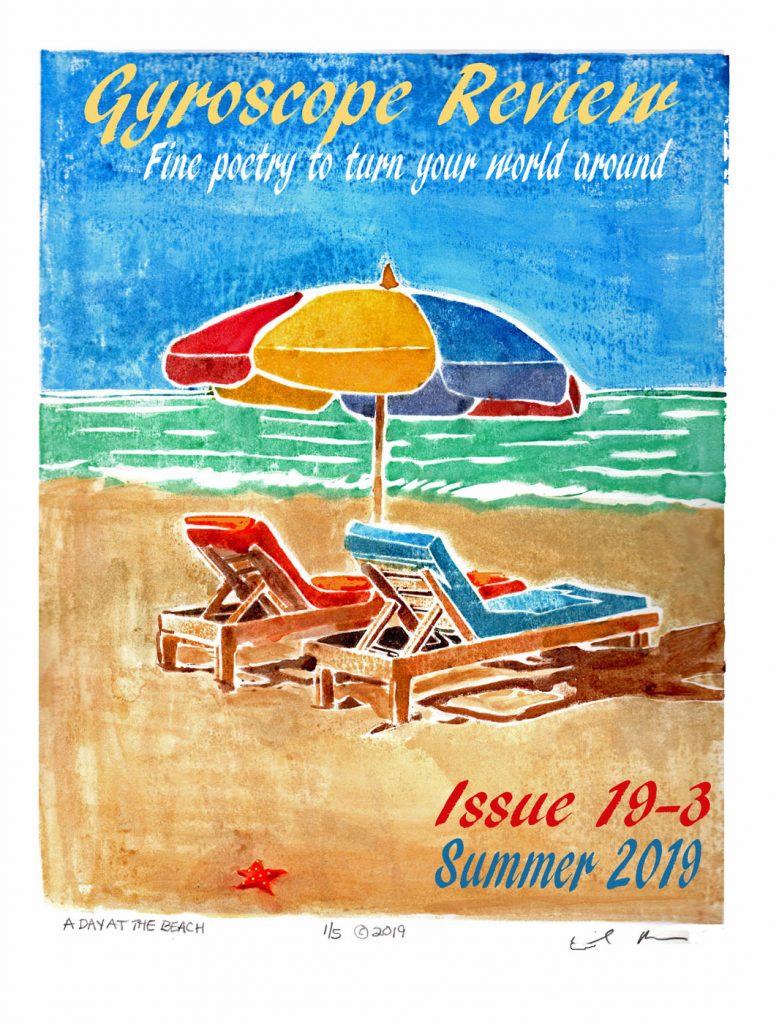
“A Day at the Beach”
by Constance Brewer
Whiteline Woodblock print
11 x 12.5 inches
Stonehenge paper
Daniel Smith watercolors

The summer issue of Gyroscope Review is out! A perfect lazy-summer-day read. You can pick up a copy on Amazon. Please leave us a review after you’ve read through the awesome work by our summer poets.

Submissions for the Fall Issue open today also. Last fall’s Crone Issue was so well-received that Gyroscope Review has decided to do it again.

The Crone Power Issue.

This time, there will not be regular submissions alongside the themed submissions. All submissions must be dedicated to the theme of what it is to identify as a woman over the age of 50 – the power, the satisfaction, the intricacies of being a woman over 50 in today’s society.

Women poets over 50 remain an underrepresented group and we are here to say that must change. Those who identify as Women over 50, we want to hear from you. This is your issue.

( We will return to regular poetry submissions for our Winter 2020 issue. )

Back to Top